

In times of crisis, have you lost your appetite or felt like you were reliving scenes from a horror movie in your fragmented sleep?
Last week I worked 80 hours on the front lines of a crisis situation. My body and brain went into shock witnessing the acute trauma. So I want to share what my own healing team has guided me to pursue, and what I’ve been sharing with my colleagues. The concept is: Feel, Heal, and Deal.
There’s a lot going on in the world, and a crisis can hit your family and your work at the same time. If you’re reading this, you’re a high-functioning adult and professional, and you’re still expected to give 150% to your company and your family. But sometimes your body betrays you.
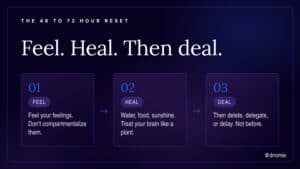
Feel, Heal, and Deal is a 48- to 72-hour reset for when your body is in shock.
But first I have to admit something controversial: I’m definitely into pumpkin season. I recently found out so are the family members who have been making fun of me for the last 10 years. Don’t judge. Perhaps it is a genetic variation?
Feel, Heal, and Then Deal
I’ve completely abandoned my protein- and fiber-based Mediterranean diet and was dealing with waves of nausea. The only thing my stomach can handle right now is bone broth and the gluten-free pumpkin muffins and crackers I found at Trader Joe’s. I was genuinely worried about myself and, with disrupted sleep, wondering if I was losing my mind.
Thankfully, a colleague checked in on me, and I fully expected them to judge me. They didn’t. They said, “Well, you need to go back and get the pumpkin butter, because it’s just not good without the pumpkin butter.” And in that moment it felt safe to feel my feelings.

Step 1: Feel Your Feelings
Feel your feelings. Don’t compartmentalize them, even though most of us are very good at it.
Shocking news or trauma throws off the brain circuits that run hunger, thirst, digestion and sleep. You might lose your appetite or feel nauseous eating your usual foods. You might not be able to finish a glass of water. You might have nightmares, or feel like you’re in a movie replaying the bad news over and over. I’ve had most of these this week.
Step 2: Heal Your Brain
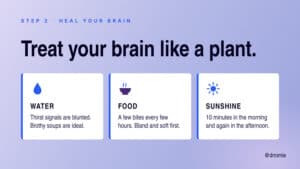
Treat your brain like a plant. Water, food, sunshine.
Your hunger signals are blunted, so bring food back gently. Set an alarm every few hours and eat a few bites. For the first day or two, stick with bland, soft foods like bananas, rice, soft potatoes and toast. Hold off on heavy protein, dairy and fried foods for now.
Thirst signals are blunted too, so it’s easy to get dehydrated without noticing. Brothy soups are ideal.
Get outside for at least 10 minutes of sunshine in the morning and again in the afternoon to help reset your circadian rhythm. And hug a person or an animal, with permission.
Nightmares are normal right now. Part of the brainSHIFT protocol is magnesium glycinate, if it makes sense for you. Skip the NyQuil and the wine, because both make nightmares worse.
Step 3: Deal With the Most Crucial Operations
Then, after you’ve felt it and started to heal, you deal with the family matters and the work. Not before. In a frazzled state, the brain is going to make every task feel like a crisis. Sit down with a colleague or family member and figure out what you can delete, delegate, or delay.
Protect Your Brain
Here’s the most surprising thing I found. If you keep replaying something upsetting in your head, the research says play Tetris.
Psychologist Emily Holmes and her team at Uppsala University studied close to 100 NHS healthcare workers who’d been through trauma on the job, like watching patients die during the pandemic. One group did a short guided session where they played Tetris and then pictured the blocks falling in their mind. The game keeps the visual part of your brain busy, so the upsetting images don’t stick as strongly.
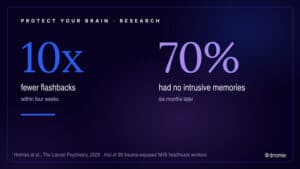
The results came out in The Lancet Psychiatry this year. Within four weeks the Tetris group had ten times fewer flashbacks than the other groups, and six months later 70% of them had no intrusive memories at all. (Read the study summary from Wellcome.)
Protect Your People
My colleague didn’t try to fix me or judge my food choices. Instead, they just made it safe for me to be a person. So when someone on your team tells you they’re struggling, maybe skip the advice and ask what they’re snacking on.
And if your symptoms last longer than 72 hours, please talk to your doctor or therapist.
Now I’m going to smear some pumpkin butter on my pumpkin cranberry crackers and go back to trying to get past level 3 on Tetris.
I see you. I hear you. I believe in you,
Dr. Romie